Competitors
12
🚀
Discover 50+ More Competitors
This is just the tip of the iceberg. Unlock comprehensive insights into your competitive landscape.
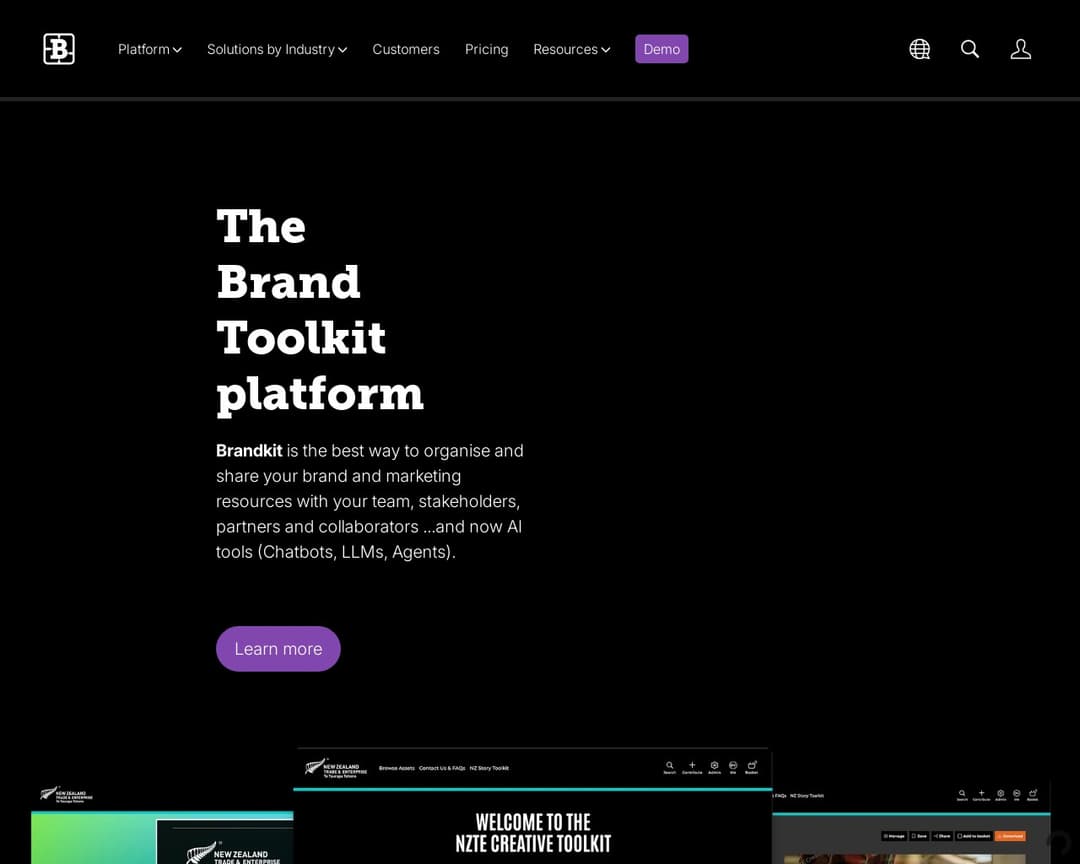
Unlock Full ReportBrandkit is a comprehensive digital asset management (DAM) and content management system (CMS) platform designed to help organizations organize, manage, and share their brand and marketing resources. It offers features like a self-serve brand portal, visual search engine, brand guidelines management, and various integrations, catering to diverse industries and use cases.
5 of 5
Centralized Asset Storage
Brand Guideline Editor
Shareable Brand Guide URL
Version Control & Updates
Asset Organization & Search
11 of 13
Logo Variant Upload
Color Palette Definition
Typography Settings
Customizable Sections
Preview Mode
Google & Custom Fonts
Real-time Collaboration
AI Consistency Checker
Automated Notifications
Whitelabel Agency Mode
Integration with Design & Dev Workflows
Asset Generation Tools
Browser Extension Access
Brandkit is a strong match for the ybrand concept. It explicitly offers a 'Brand Toolkit Platform' which functions as a centralized hub for brand and marketing resources, aligning with the 'centralized-asset-storage' feature. The website mentions 'Brand Guidelines with Automatic attachment' and 'Digital Brand Guidelines in the CMS', indicating a 'brand-guideline-editor' and 'shareable-brand-guide-url'. The platform also highlights 'Versioning' and 'Upload new versions of Assets with history and Roll-back', covering 'version-control-and-updates'. 'A powerful visual search engine' and 'Batch Editing and Tagging' directly support 'asset-organization-and-search'. Many 'other' features are also present, such as 'AI Auto-tagging' (related to AI consistency checker), 'Multiple User Roles and Permissions' (real-time collaboration), 'White-label DAM for Agencies', and 'API Integrations'. While specific mentions of color palette definition and typography settings are not explicitly detailed as standalone features, the comprehensive nature of their 'Brand Guidelines' and 'Custom Design' capabilities strongly imply their inclusion.
I've been using Alternative A for 6 months now and it's been fantastic. The pricing is much better and the features are actually more robust than what [Product] offers.
It handles edge cases much better and the API is actually documented properly.
Check it out at our site.
Honestly, after trying both, Competitor B wins hands down. Better customer support, cleaner interface, and they don't nickel and dime you for every feature.